A floor lamp is more than just a source of light; it is a design statement that defines the mood and architecture of a room. In the world of Danish design, floor lamps are celebrated for their ability to combine soaring, sculptural forms with intimate, functional lighting. At Danish Design Classics, we offer a curated selection of floor lamps that represent the pinnacle of Scandinavian lighting philosophy.
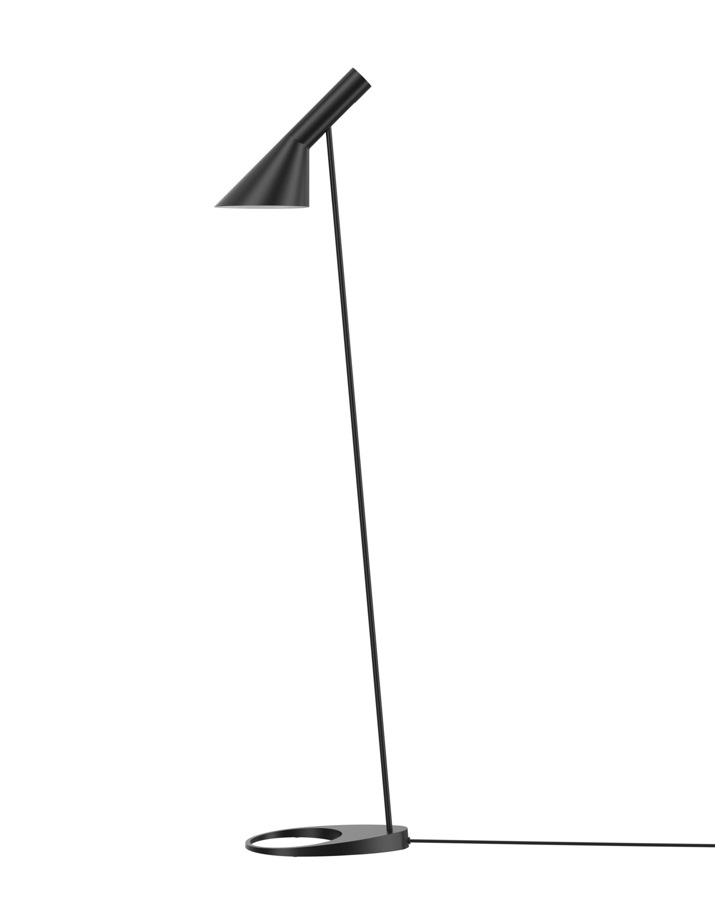
The AJ lamp was designed by Arne Jacobsenin 1960 to SAS Royal Hotel in Copenhagen (Radisson Blu). The lamp was part of the overall design concept of the hotel. Several of the hotel’s products have today obtained the status of design icons, and in the field of lighting, especially the AJ lamps have become world-renowned.
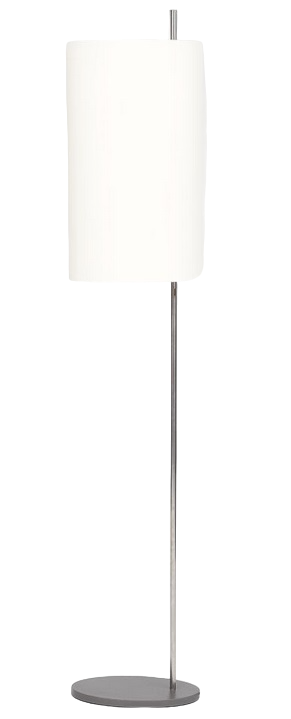
AJ Royal Model 28710 is designed by Arne Jacobsen for the Royal Hotel in Copenhagen.The lamp is made of lacquered steel with a shade of fabric.The lamp stands out a lot and does not look like some of his other models.
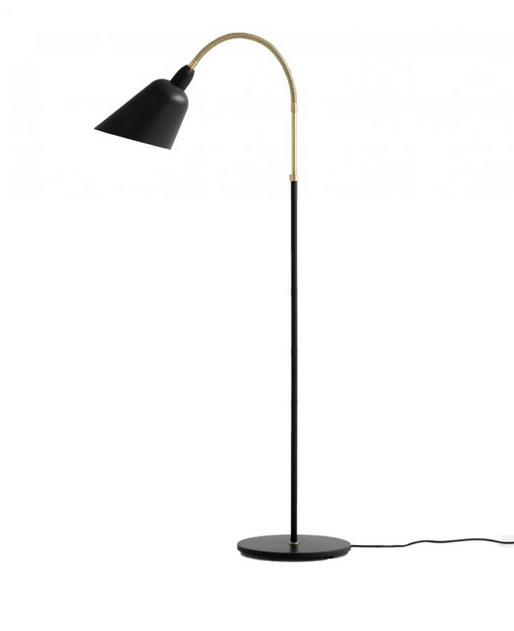
The Bellevue table lamp was designed in 1929 by Arne Jacobsen as the first lamp series from the master’s hand. Production and design is a speck shot from the Bauhaus period and the screen with its cutting of the 45 degrees is also seen going again at the famous Bellevue gas station.
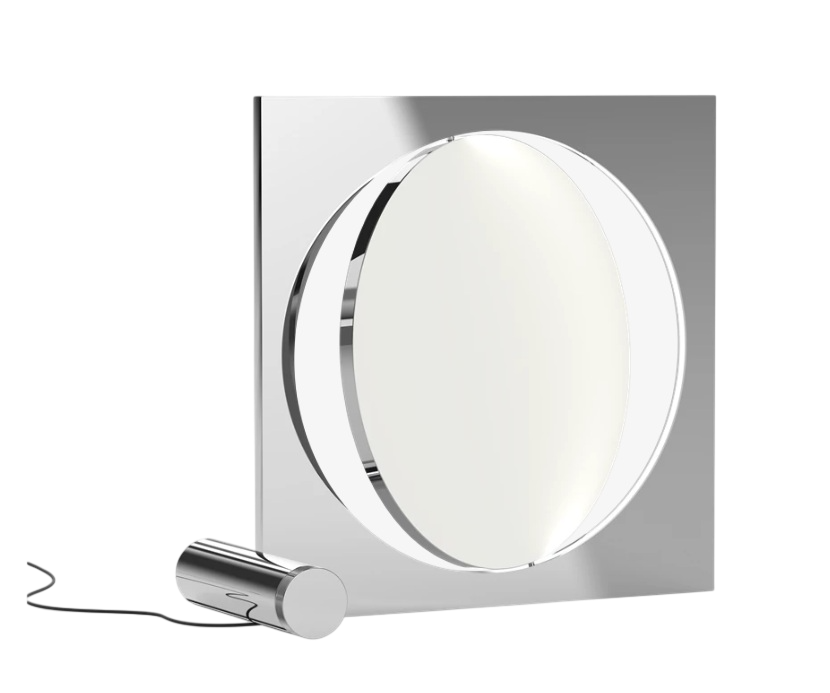
Moonsetter by architect and designer Anne Boysen was the winning design in the Next Danish Design Classic competition broadcast on national Danish television in 2020. The competition judges immediately recognised the qualities of Moonsetter with its simple design, clean lines and timeless feel. The design of Moonsetter is based on basic geometric shapes with the circle, square and cylinder merged in a unique and artistic configuration. After creating the first prototype of the floor lamp for the design competition, Anne Boysen entered into a partnership with Louis Poulsen to continue design iterations. In 2021 the lamp was introduced in Denmark in numbered editions of 100 pieces. The sculptural aesthetic of the floor lamp takes centre stage in any interior, almost like a piece of art. Its 360° rotating disc, which has a different finish on each side, allows us to play around and decide how the light should be reflected in the room – and exactly how the room should be reflected in the mirror surface of the lamp. Moonsetter invites us to interact and explore – seeing not only the quality of the design – but feeling it and sensing it too. Moonsetter blurs the lines between sculpture and light source and serves an aesthetic purpose as well as a functional one. The impactful size of Moonsetter naturally attracts attention and creates a room within the room that can be shaped through reflections and light. The lamps are numbered in editions of 100 pieces per edition and will be engraved with edition number and a unique sequential number from 1 – 100.
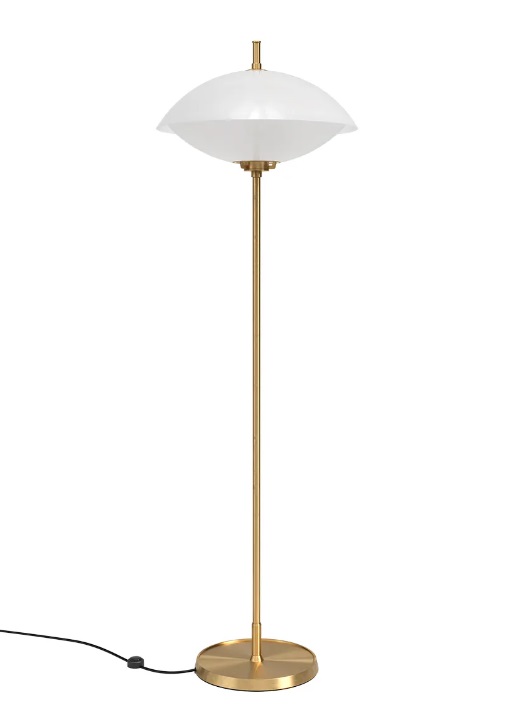
The seashell-inspired Clam™ lamp series designed by Ahm & Lund, shines a luminescent pearl of light from within. The contemporary design has a timeless aesthetic that illuminates spaces with mood-enhancing light. All lamps in the Clam™ series are designed to complement each other and work well together. The floor lamp works beautifully to set a cosy atmospheric mood in lounge areas and dining spaces.
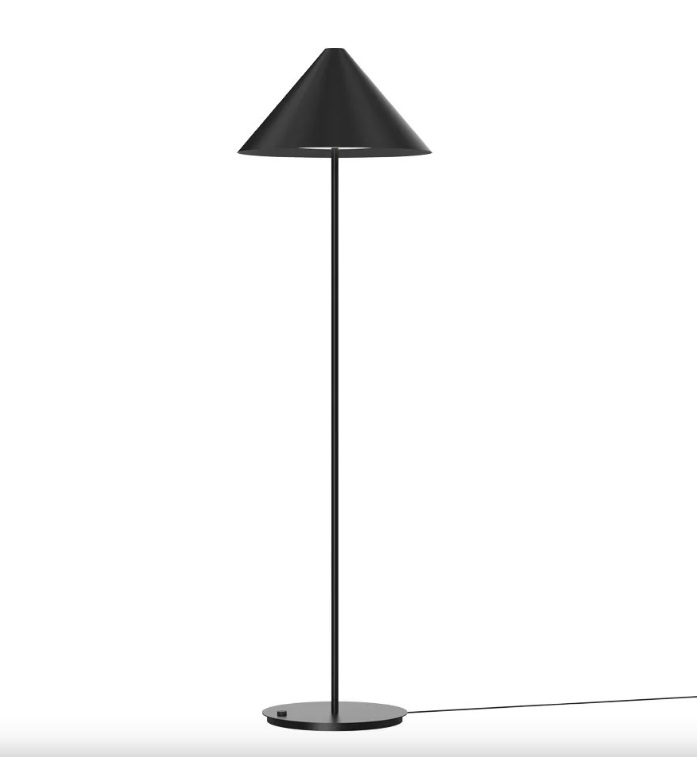
Keglen was created by BIG Ideas in collaboration with Louis Poulsen in 2017. The aim was to create a simple but unique lamp focusing on the geometry and essence of the light. The collaboration between Louis Poulsen and BIG Ideas started with the development of a pendant for the Tirpitz Museum in Blåvand, Denmark. BIG had designed the building, and the pendant’s edgy, galvanized finish encapsulates the museum’s fine yet robust architecture, which melts into the dune landscape of West Jutland. This artistic and technical lighting collaboration between Louis Poulsen and BIG Ideas continued, and it has now resulted in the further development of the Keglen family, whose simple geometry works beautifully in any kind of interior. The design of Keglen aimed to create a systematic design language that would provide the opportunity for a wide range of lighting typologies. In other words, Bjarke Ingels, Jakob Lange, and the design team from BIG Ideas wanted to create a family of lamps with the same qualities and design details in various sizes, but each with a unique personality. Jakob Lange and Bjarke Ingels explain that the geometric and metallic shades have a soft, organic glass insert that resembles a drop of water. In the table and floor versions, the glass insert meets the lamp stem and flows organically around it like liquid exhibiting surface tension. Keglen Floor builds on the same family as the Ø400 Keglen Pendant. The design is based on the same shade, where the stem morphs into the bottom diffuser to fold it inward and create a beautiful organic geometry, similar to the Keglen Table lamps. The stem and base are designed to be as graphic and simplistic as the cone-shaped shade.
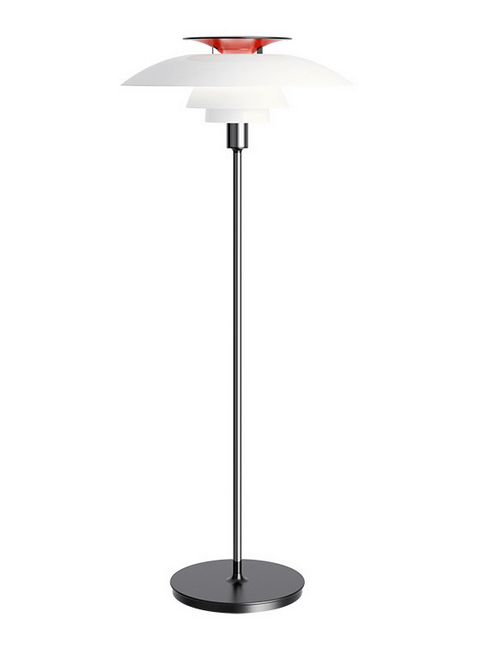
The PH 80 floor is based on the same 3-screen principle and with the logarithmic spiral as a starting point. The material is opal acrylic and the top screen is red to give a warm and atmospheric light. The lamp number does not refer to the diameter of the screen as normal in the 3-screen system. The lamp was made after Poul Henningsens death to mark his 80th birthday in 1974 – hence the name PH 80.
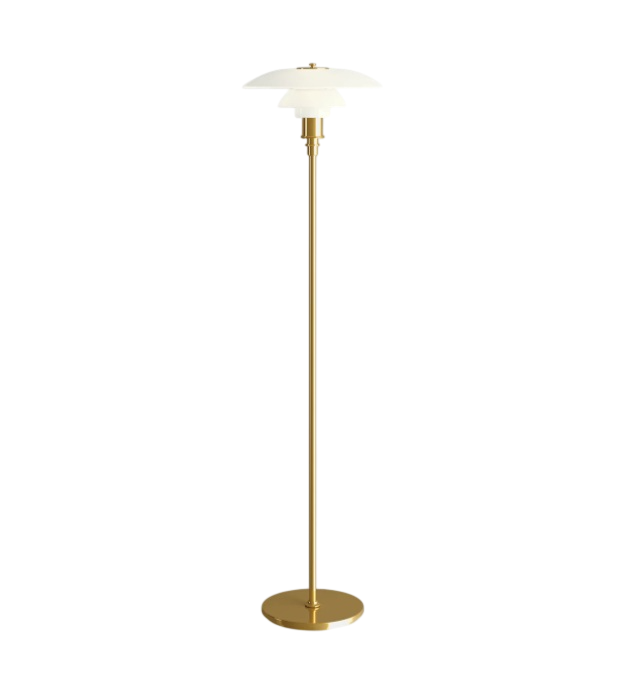
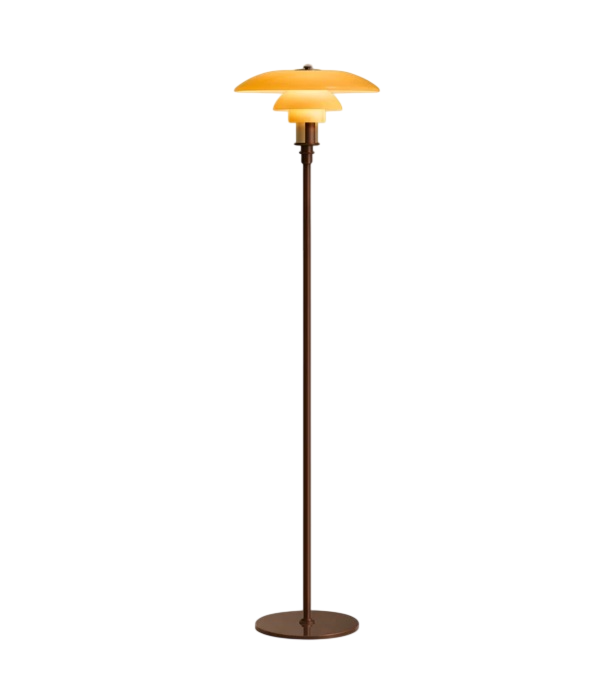
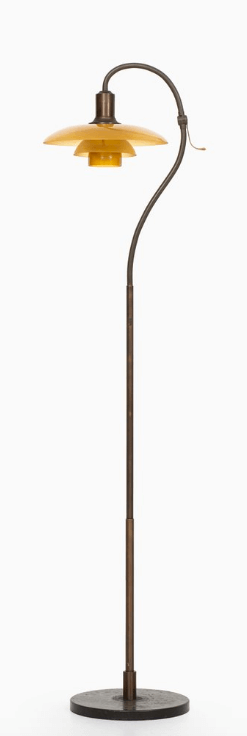
The 3½-2½ Floor light is a member of the three-shade family which numbers 30 lights today, including three for outdoor use. Thus PH did not just design a light, but an entire system – around a thousand different models have been produced over the years. This wide selection consisted of table, floor and wall lamps, as well as a number of different chandeliers, which were very popular in the 30s for lighting private homes from high ceilings. There were countless combination options. The lights were available in different colours, as well as a range of sizes. The first shades were made of metal with a painted undersurface, such as white, gold or silver – depending on whether diffuse, warm or cold light was desired. Glass was later introduced for the three-shade system. In addition to the downward-directed light, glass lamps illuminated the room. PH was the first person to pursue a scientific approach to light and use the logarithmic spiral as a basis. By using a design based on the logarithmic spiral he achieved even distribution of light over the entire curve of the shade. This even light distribution, together with the diffuse reflection through the glass, made it possible to control glare and shadow. Each shade reduces the amount of light equally, due to their distance from the light source. The PH light model numbers refer to the shade size. Each top shade had a corresponding set of middle and lower shades. In the ‘pure’ models, such as the 2/2, the top shade has a size of about 20 cm, with corresponding lower shades. PH 3½-2½ Floor consists of an approximately 35 cm top shade with lower shades. These ‘hybrid’ models were introduced due to the desire to hang pendants at lower heights. The system was also used for floor, table and wall lamps. PH 3½-2½ Floor in its current form was introduced in 2002.
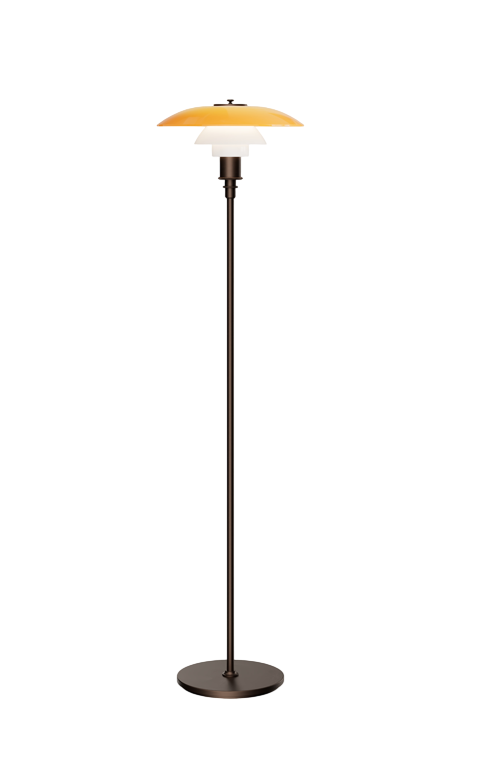
This exquisite PH 3-½-2½ Floor Lamp, crafted with aged brass and four-layer mouthblown glass is part of the Louis Poulsen | FENDI Casa collaboration, which debuted at Milan Design Week in 2023. Each of the pieces in the collection are reimagined versions of iconic Poul Henningsen designs, that subtly reflect FENDI’s distinctive design language through pequin stripes and a luxurious colour scheme. With this collaboration Louis Poulsen and FENDI Casa have come together and created a collection of products that reflect a common approach to craftmanship, innovation and heritage, while exploring the idea of duality merging Danish design tradition and Italian excellence, resulting in modern interpretations of products created almost 100 years ago.
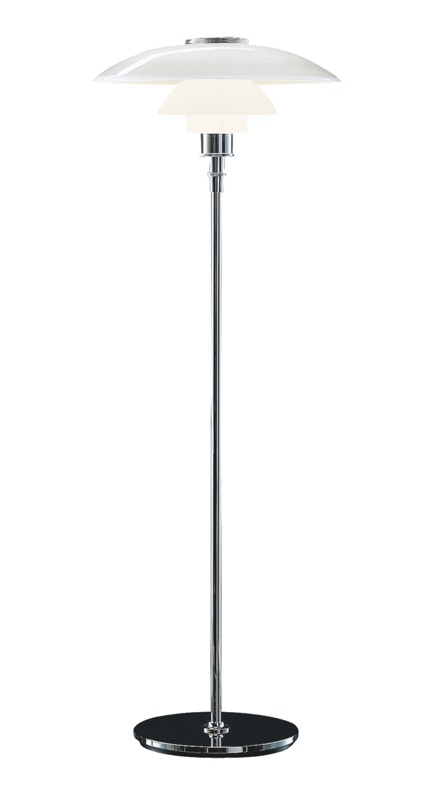
PH 4½-3½ Glass Floor is a member of the three-shade family which numbers 30 lights today, including three for outdoor use. Thus PH did not just design a light, but an entire system – around a thousand different models have been produced over the years. This wide selection consisted of table, floor and wall lamps, as well as a number of different chandeliers, which were very popular in the 30s for lighting private homes from high ceilings. There were countless combination options. The lights were available in different colours, as well as a range of sizes. The first shades were made of metal with a painted undersurface, such as white, gold or silver – depending on whether diffuse, warm or cold light was desired. Glass was later introduced for the three-shade system. In addition to the downward-directed light, glass lamps illuminated the room. PH was the first person to pursue a scientific approach to light and use the logarithmic spiral as a basis. By using a design based on the logarithmic spiral he achieved even distribution of light over the entire curve of the shade. This even light distribution, together with the diffuse reflection through the glass, made it possible to control glare and shadow. Each shade reduces the amount of light equally, due to their distance from the light source. The PH light model numbers refer to the shade size. Each top shade had a corresponding set of middle and lower shades. In the ‘pure’ models, such as the 2/2, the top shade has a size of about 20 cm, with corresponding lower shades. PH 4½-3½ Glass Floor consists of an approximately 45 cm top shade, but uses lower shades from the 3½ model. These ‘hybrid’ models were introduced due to the desire to hang pendants at lower heights. The system was also used for floor, table and wall lamps. PH 4½-3½ Glass Floor in its current form was introduced in 1990.
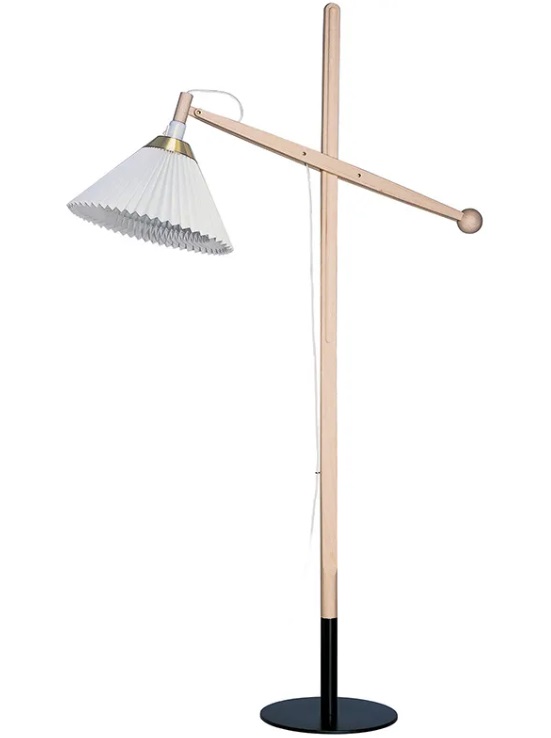
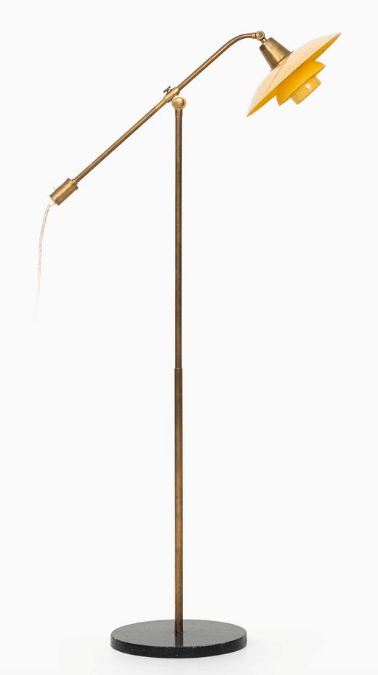
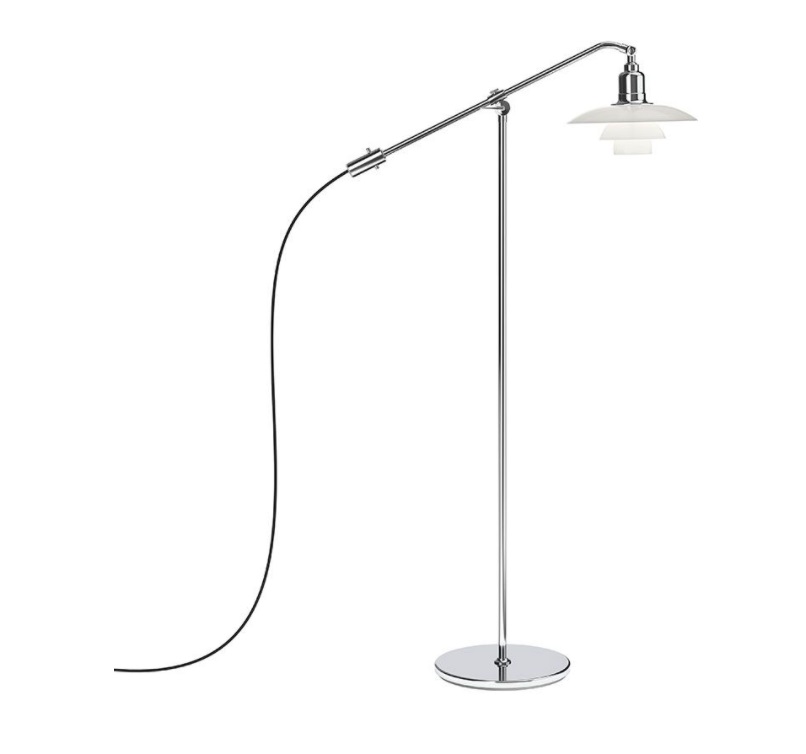
In the 1950s, Louis Poulsen introduced a new reading lamp by Poul Henningsen, the celebrated pioneer of Danish design. Because of its adjustable arm that can be levered up and down, the lamp was immediately dubbed ‘The Water Pump’. In honour of Poul Henningsen’s legacy.
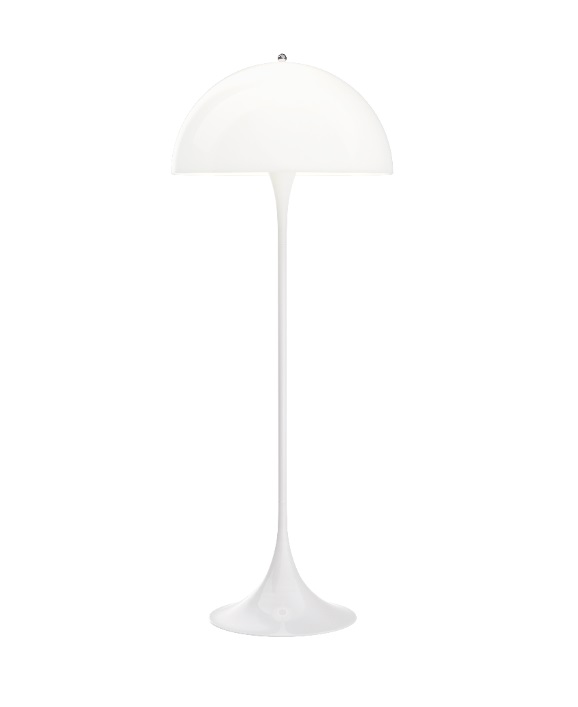
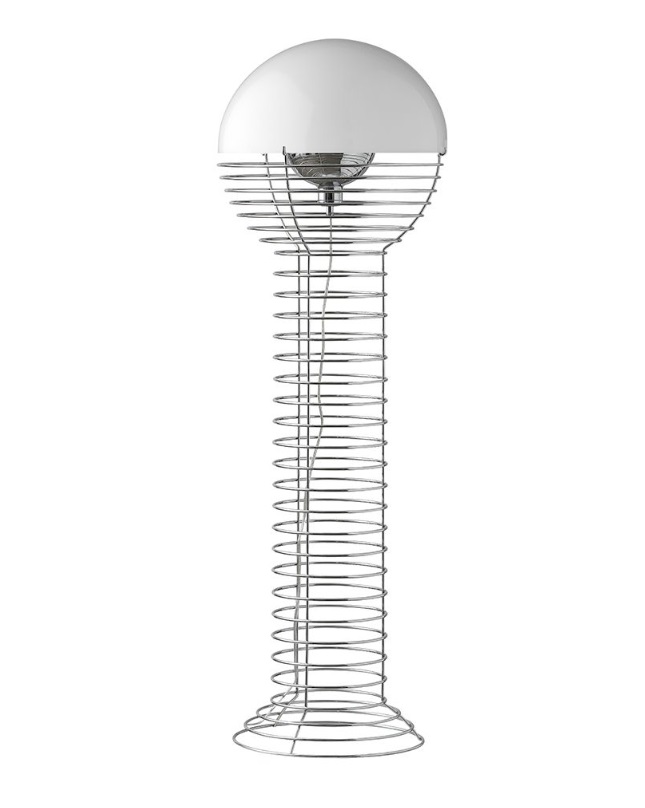
The designer and architect Verner Panton created Panthella together with Louis Poulsen in 1971. Panton’s figurative and playful design radiates his larger than life personality. Without compromising on quality or functionality, the world-renowned Dane continued to develop new materials for the colourful and captivating spaces that he created out of his enticing designs.
Panthella stands out as one of Panton’s most significant design icons with its organic shape that mirrors the softest of light. Panton intended to create a light where both the stand and the shade served as a reflector, combining it with the organic shapes the Danish designer is known for. With its non-glaring light, Panthella serves as a beautiful example of Verner Panton’s brilliant sense of creating atmospheric illumination.
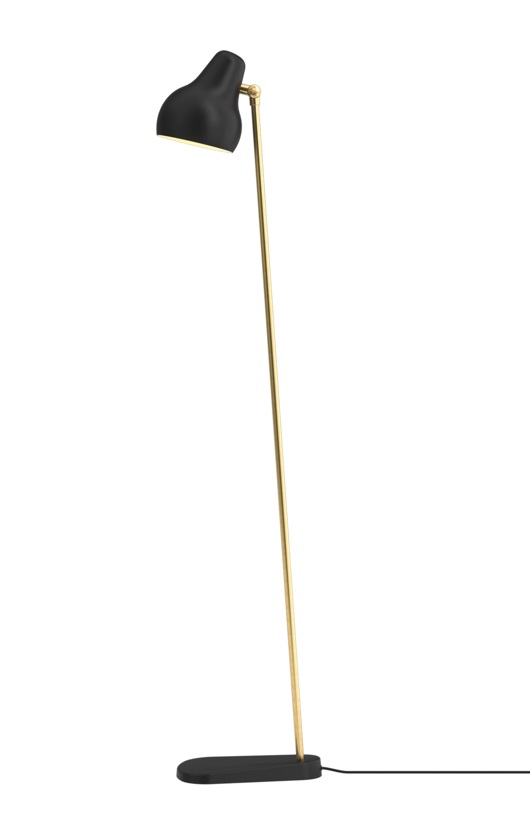
This beautiful and organic floor lamp is designed by the Danish designer Vilhelm Lauritzen.The lamp is part of his VL38 series. It is made of brushed brass and is available in both black and white.
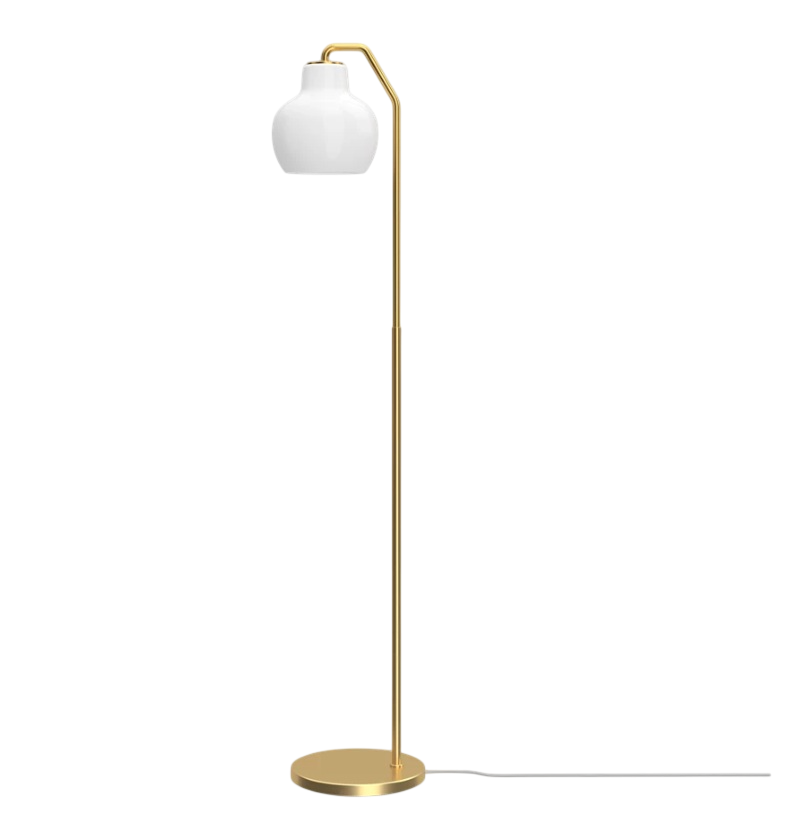
Introduced in 2025, the VL Ring Crown Floor and Table lamps honour the original VL Ring Crown series, which has a history spanning over 80 years. The VL Ring Crown lamps are part of a series that include a pendant, chandeliers and wall lamps, created by the Danish architect Vilhelm Lauritzen for Radiohuset (The Radio House), headquarters of the Danish Broadcasting Corporation, which was inaugurated just after World War II ended in 1945.
Staying true to the original design and materials, the VL Ring Crown Floor and Table lamps feature polished brass and glossy, three-layered, mouth-blown opal white glass shades, beautifully complementing the lamp designs originally installed in Radiohuset. Vilhelm Lauritzen also designed the VL 38, VL Studio and VL 45 lamps for Radiohuset.
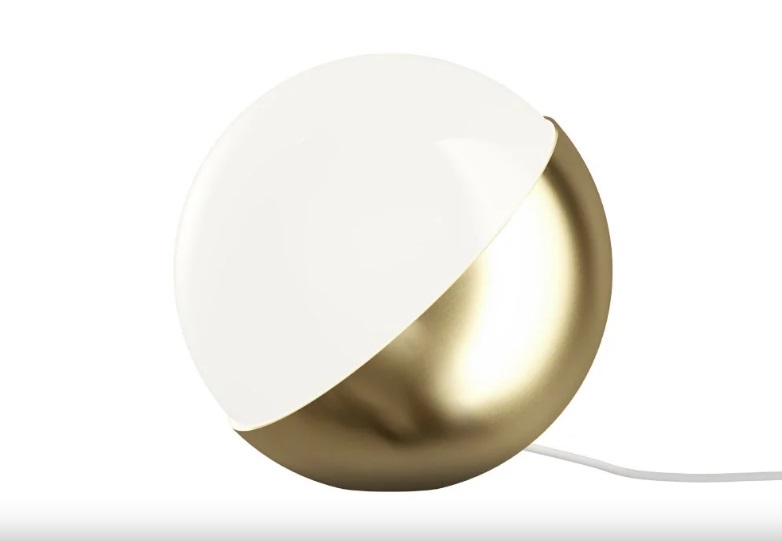
The VL Studio Lamp, designed by Danish architect Vilhelm Lauritzen, is a timeless example of functional and elegant lighting design. Originally created in the 1940s for the Radiohuset (the Danish Broadcasting House) in Copenhagen, the lamp was designed to provide optimal working light while maintaining a calm and refined aesthetic.
The VL Studio Lamp is characterized by its simple, spherical glass shade, which distributes light evenly and creates a soft, glare-free illumination. Its balanced proportions and minimalist form reflect Lauritzen’s architectural approach, where lighting is carefully integrated into the surrounding space. The lamp works equally well as a table lamp, floor lamp, or wall-mounted version, making it highly versatile.
More than just a light source, the VL Studio Lamp embodies Vilhelm Lauritzen’s belief that good design should be both practical and human-centered. Its enduring design continues to feel modern today and stands as a classic piece of Danish design history.